
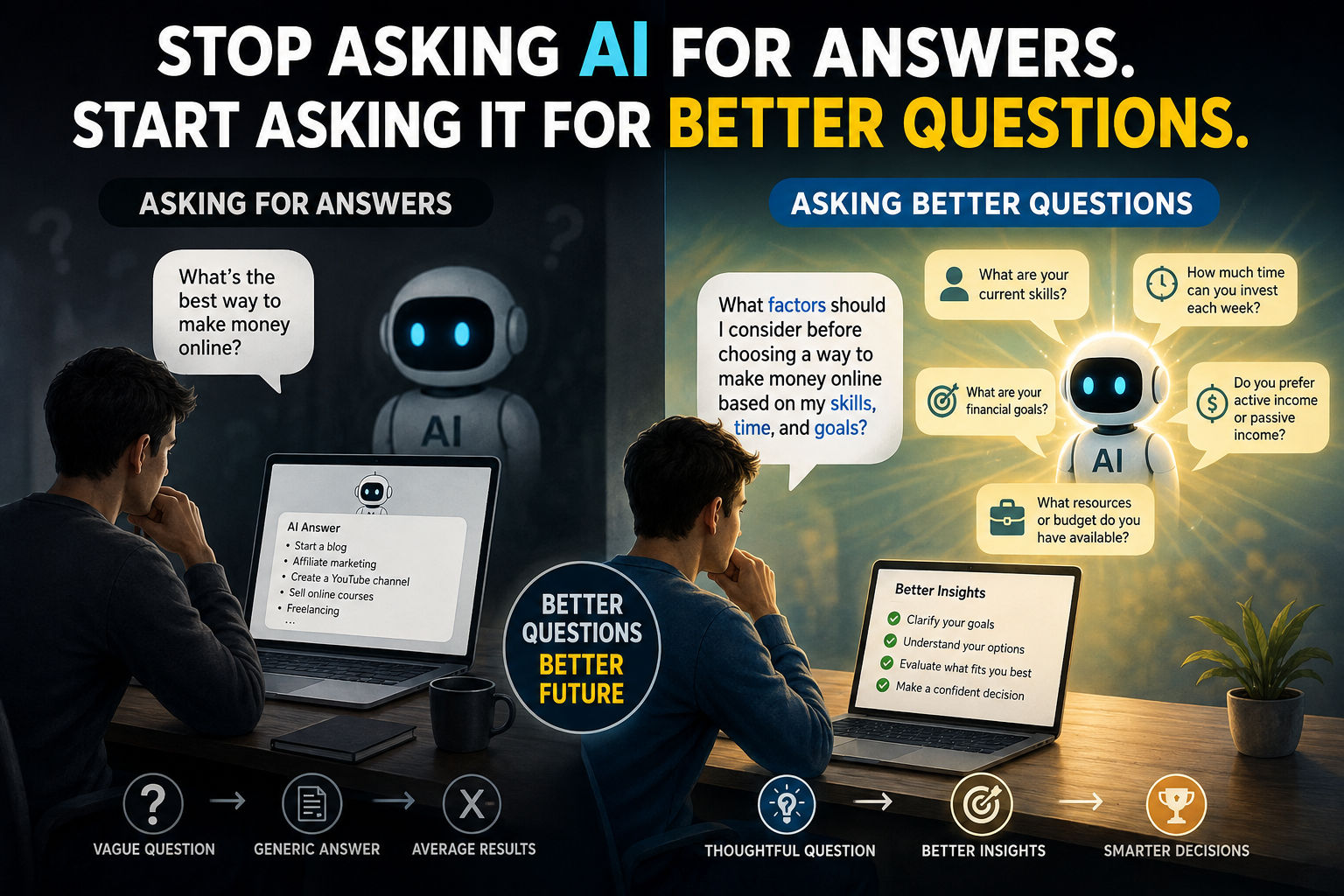
Stop Asking AI for Answers. Start Asking It for Better Questions.
Artificial intelligence has fundamentally changed the way we search, learn, work, and solve problems. Today, anyone can ask an AI tool almost any question and get an answer in seconds. But there is one huge issue with this approach: most people are asking the wrong questions.
We've fallen into the trap of chasing more and faster answers when what we really need are better questions.
Instead of asking,
"What should I do?" try asking, "What am I missing?" Instead of asking for the "best" something, try exploring possible options and their trade-offs
Asking better questions can make a world of difference.
The future of AI productivity lies not in learning how to use artificial intelligence but in learning how to ask better questions to AI.

Why Better Questions Often Matter More Than Better Answers
An AI tool can provide an impressive answer to almost any question. But an impressive answer isn't always a useful answer
Let's say you're looking to create a website.
You could ask:
“Give me a website idea that can make money.”
This is a perfectly valid question, but the long-winded answer listing out blog sites, affiliate sites, SaaS products, newsletters, tools, marketplaces, and more won't be particularly helpful to you. After all, which of those options is the best fit for your unique combination of skills, budget, time constraints, etc.?
A much better question would be something like,
“I have limited technical experience, a small budget, and five hours per week to commit. Ask me the questions you need to determine which type of website would be the best fit for me.”
Now you've shifted the conversation from one where you're answering general questions to one where you're helping the AI understand your unique situation.
This is one of the most promising developments in productivity and prompting - the shift from answer-getting to thinking-assisting.
Google's guidance for helpful content is similar - emphasizing content that provides value and originality, and writing for people rather than for search engines.
AI Should Be Your Thinking Partner, Not Just Your Answer Machine
There's certainly nothing wrong with asking an AI for an answer. If you're looking for an explanation, analysis, summary, idea, or opinion, an AI can be extremely helpful in providing one.

The problem comes when we let an AI do all the thinking for us.
Let's take a look at a couple of weak prompts and their stronger alternatives:
For example:
Weak question:
“Should I learn Python or JavaScript?”
Better question:
“Compare Python and JavaScript for my purposes of learning automation, web development, and AI. Ask me five questions first, then give me a recommendation based on my answers.”
The second prompt is stronger because it creates space for a back-and-forth conversation. After all, most real-world decisions aren't made by evaluating one piece of information - they're made by investigating and analyzing a situation based on your needs, limitations, preferences, experience, risks, and alternatives.
The Most Powerful AI Prompt May Be, "What Am I Missing?”
This simple question can be applied to almost any task following an initial response.
Ask yourself:
“What important information am I missing?”
Then follow it with:
“What assumptions are you making?”
And finally:
“What could make your recommendation wrong?”
Asking an AI to identify what information it's missing can be a fantastic way to think through a recommendation.

For example, if you're asking for advice on a marketing strategy, don't accept the first answer. Instead, ask the AI to explain what assumptions it's making, what risks it foresees, what strategy would be the worst fit, what evidence it would need to support your strategy, and what other strategy it thinks would be a better fit.
Asking these types of questions turns an answer-generating machine into a full-fledged brainstorming partner.
Ask AI to Ask You Questions
This is probably the best piece of advice in this entire article. When using an AI, always ask it to ask you questions.
Most people will begin their query with something like,
“Here is my problem. Can you give me a recommendation?”
But what if you turned it around and asked,
Say:
“Before you give me a recommendation, can you ask me the questions you need answered first?”
This approach works particularly well with career advice, website ideas, learning plans, marketing advice, business planning, software testing, personal development, content creation, or any other situation where you're unsure of your own needs
Why?
Because it's much harder to define a problem than it is to solve one. And there's value in letting an AI walk you through their understanding of your situation.
Use AI to Challenge Your Thinking
Another good prompting technique is to ask an AI to disagree with you.
For example:
“I believe this is the best option. Try to convince me otherwise.”
Or:
“Act as a critical reviewer. Find the flaws in my arguments.”
Or:
“Give me the strongest reasons not to pursue this idea.”
These prompts are useful because they challenge us to think critically of our own ideas, a concept known as "cognitive dissonance" in psychology.

Remember that, while an AI can be an excellent truth-seeking partner, it is still an AI. If something important to you is at stake, always fact-check, confirm, and verify information with trusted sources, especially when it comes to finance, medicine, law, security, and other critical areas.
What's the Difference Between "The Best" and "What's Best for Me?"
One of the most common mistakes in AI prompting is using the phrase:
“What's the best?”
One of the simplest ways to improve your prompts is to avoid asking for "the best" something. "The best" can mean many different things - price, quality, speed, ease of use, and long-term value, just to name a few. Ask yourself,
"Best according to what criteria?" and "What trade-offs am I willing to make?"

Instead of asking for "the best" option, ask for "best according to X criteria" or "based on my limitations."
For example:
“Compare these three options for price, learning curve, level of automation, community, and long-term value. Score each option and explain the trade-offs.”
This is a much better prompt than, "What's the best option?"
Turn One Question Into a Conversation
The most useful prompts aren't always self-contained. Sometimes you have to have a conversation with an AI.
This means asking a general question, then digging into specifics. For example, say you're trying to learn about SEO for a new website.
First, ask a general question, like, "Explain how SEO works for a new site."
The next question could be something like, "What are the three biggest mistakes beginners make?"
Follow-up with a prompt like, "How would those mistakes hurt my website specifically?"
Finally, ask for a recommendation like, "Create a detailed 30-day plan based on the problems I'm facing."
Then end with something challenging like, "Act as an SEO auditor and tell me what I'm doing wrong with my plan."
This gets you much farther than simply asking the AI to give you a 30-day SEO plan.
Better Questions Also Improve AI Blogging, Marketing, and SEO
This one is especially vital for bloggers and marketers who want to use AI for content creation. Remember that Google's helpful content guidelines stress value, people-first language, and avoidance of large-scale content generation for the sake of quantity.
Many of the tactics mentioned earlier still apply, but keep in mind that, while an AI can be extremely helpful with research, outlines, and editing, it shouldn't be relied upon to simply write content that's easy to produce. Not only is this a questionable SEO practice in general, but Google is reportedly cracking down on content farms that use AI to generate massive amounts of low-quality content.
Instead of asking the AI to write an article, try asking something like,
“Write a 2,000-word article about SEO.”
Ask:
“What are the questions I'm still confused about when it comes to SEO? What are the gaps in my knowledge that I should address? Suggest an original angle on SEO that answers my questions and explain how I should structure the article.”
That's a much better approach to SEO writing than telling an AI to write an article on SEO and calling it a day.
Other great resources for SEO and content writing include Google's Search Essentials and SEO Starter Guide, which give much-needed context and guidance for search-friendly, people-first writing.
A Simple Framework for Asking Better AI Questions
A lot of the best prompting advice follows a simple framework:
Goal → Context → Constraints → Questions → Challenge
1. Goal
Tell AI what you are trying to accomplish.
“Explain what you want to accomplish. For example, "I want to increase traffic to my website."
2. Context
Explain your situation.
“Tell the AI about your situation. For example, "The website is six months old and has little traffic."
3. Constraints
Mention limitations.
“Share any limitations. For example, "I have little budget and can only publish three articles per week."
4. Questions
Tell AI to identify what it needs to know.
“Tell the AI to ask you specific questions. For example, "Ask me the five most important questions before recommending a strategy."
5. Challenge
Ask AI to test its own recommendation.
“Ask the AI to challenge its own recommendation. For example, "After recommending a strategy, explain its biggest weaknesses and risks."
This method is much better than simply asking the AI for traffic-building recommendations without providing much context.
“How do I get more traffic?”
The Real Skill of the AI Era
AI is driving the cost of information to near-zero. Information itself is becoming commoditized. The most valuable skill in the future will be knowing what to do with that information.

Someone who knows how to ask better questions can extract exponentially more value from an AI than someone who simply asks basic questions.
Think of it in terms of a calculator. An average calculator user can perform simple math faster than a person could do it by hand. But the most successful calculator users are those who understand how to build complex equations. An AI is similar to a calculator in that it can perform specific tasks faster and easier than a human could, but it still needs a person to operate it.
This is why the most important prompting technique in the future may not be any specific trick at all, but rather better thinking in general. The ability to think through a situation and recognize the nuance between different pieces of information is one of the most valuable prompting techniques an AI user can possess.
10 Questions to Ask AI Instead of Asking for Answers
Next time you're interacting with an AI, try these ten questions:
What am I missing?
What assumptions are you making?
What questions should I be asking?
What makes your recommendation wrong?
What are the alternatives?
What are the biggest risks?
What would an expert challenge here?
What information would change your answer?
Can you show me the trade-offs?
What should I investigate before making this decision?
These ten questions can turn a basic search into a deep conversation with an AI. Asking them can lead to more thorough recommendations, risk assessments, research, and even more thoughtful marketing, SEO, and content writing.
Final Thought: Don't Outsource Your Thinking
The future of technology and artificial intelligence will be dominated not by people who outsource their thinking to machines but rather by those who improve their natural thinking with machines.
Use an AI tool to think through a problem rather than simply asking for an answer. Ask the AI to question you. Ask it to find the missing information. Ask it to challenge your thinking. Ask it to identify what you haven't considered. Most importantly, ask it:
“What is the better question?”
That single question - "What is the better question?" - could be one of the most important prompts you'll ever enter into an AI..
Here are the 5 questions that I would investigate before writing:
1. What happens when AI delivers a convincing response to a question that the user should not have asked?
Most articles on prompting ignore the critical issue of poorly framed questions.
Investigate questions such as:
How to ask AI which career path to choose that does not reflect my personal priorities?
What is the best idea for a business to start that does not account for my personal constraints?
How might I ask AI to diagnose why my website is not growing that does not define what growth means to me?
How to ask AI to fix a technical problem that I do not understand?
The bigger danger is that AI provides a satisfactory response to an ill-posed question.
Explore the difference between asking
“Is this [X] a good idea?”
and:
“What would convince me that [X] is a good idea?”
This could form the basis of your article.

2. Why do people want an answer from AI before they are willing to allow AI to ask clarifying questions?
You can investigate this tension to demonstrate a human limitation, while positioning AI as a solution.
Ask yourself: Why do people want an answer now?
Some theories:
They do not know what information is relevant to the question,
are afraid of having to ask clarifying questions,
do not know how to phrase the question,
or believe that AI is a tool for thinking less, not more.
Another angle: they fail to realize that additional information beyond their initial request may be relevant.
Investigate the possibility that convenience may ironically undermine the user’s ability to define the problem.
A novice might think:
If AI knows everything, I do not need to explain the situation.
An expert would reply:
The quality of your answer depends on whether the question was framed correctly.
This could be the basis of your article.
3. What important questions do you wish people would ask AI that they rarely do?
This is perhaps your best opportunity to contribute something truly novel to the conversation.
Do not investigate what AI can do; focus on what it cannot.
For example, someone asks:
Should I start a blog?
An uninteresting article would explain what factors one should consider before starting a blog.
A much better article would explore the kinds of questions that people rarely ask themselves when deciding to start a blog, such as
Why do you want to start a blog?
How long are you willing to maintain a blog without any income from it?
What expertise do you have that is not available elsewhere?
Are you willing to dedicate time and effort to gain unique insights?
If your blog gets little traffic, what are you going to do about it for 12 months straight?
What is it that your blog can do better than everyone else?
Are you trying to build an audience or are you just hoping that Google will find you?
That is the kind of investigation that leads to a compelling article.
You can call it the
Missing Question Problem.
There are times when the question that we should ask AI is not obvious, and it may change the response that we get. This could lead to a discussion of cases where the real value of an AI interaction consists in asking the right question rather than getting an answer.

4. Can asking better questions of AI expose flaws in the responses that AI delivers?
This is perhaps the most compelling angle of all, because most “tips” articles do not explore this idea at all.
Investigate the nature of questioning that goes beyond asking What is the answer? and delves into such topics as
What would make your answer wrong?
What are you assuming?
What would convince you that your answer is correct?
Give me the best argument against your position.
Which part of your answer are you least confident about?
The value of investigating this direction lies in your ability to demonstrate that questioning AI can turn it from an uncritical oracle into a skeptical conversational partner. You could explore the differences between viewing AI as an expert whom one ought to believe and a self-aware thinker for whom skepticism is the default.
This would be a much better article than most of the “how to communicate better with AI” tips that one sees online.
5. What happens when the best way to use AI is to phrase questions that have no answers?
This is the question I’d ask to make this article different.
There is a certain allure in thinking that our time with an AI system has come to the point where we’re issuing a long set of increasingly precise instructions for the machine to carry out.
Perhaps the most powerful queries are actually about things your AI partner can’t reasonably be expected to handle, though.
For instance,
“What should I choose?” might take on a new form as “What values should inform my choice?”
Or think about “Which business should I start?” and how it might take on the form of “What problem am I best poised to solve in a new endeavor?”
How about the age old query “How do I make my website successful”? It might instead be phrased as “What would make someone select this site over the other 300,000 options also seeking traffic.”
Financial Freedom in 2026: Smart Money Strategies to Build Wealth
See what I’m getting at here?
These are all questions that still demand your judgment, but in different ways than you might be used to.
That could be your article’s thesis.
Perhaps its punchline.
The point is that this is a chance to highlight the idea that the value of AI is in recognizing the limits of our own thought processes, provided we ask them to.